SEO is Not Dead – But It’s Not Enough Anymore
If your business still relies on SEO alone to drive leads, you’re leaving money on the table. Here’s what’s changed — and what UAE businesses need to do about it.
In this article:
Here’s a story that might sound familiar.
Wil Reynolds, CEO of Seer Interactive one of the most respected digital agencies in the world watched his company’s organic search traffic drop by 41% in 2024. That’s not a typo. Nearly half their organic traffic, gone.
But here’s the twist: their revenue didn’t drop. Their leads didn’t dry up. In fact, their newsletter signups grew by 65%.
How? Because Reynolds saw something coming that most businesses still haven’t grasped. The way people discover and choose businesses has fundamentally changed. Traffic used to equal revenue. Now, the relationship between rankings and results is breaking apart and the companies that recognized this early didn’t just survive the shift. They came out ahead.
If you’ve noticed your website traffic flattening, your click-through rates dropping, or your content getting fewer leads than it used to even though your rankings look fine you’re not imagining things. And you’re not alone. Businesses across every industry are seeing the same pattern: impressions up, clicks down, and the traditional playbook delivering diminishing returns.
SEO is not dead — but the numbers tell a bigger story
Let’s be clear about one thing first: SEO is not dead.
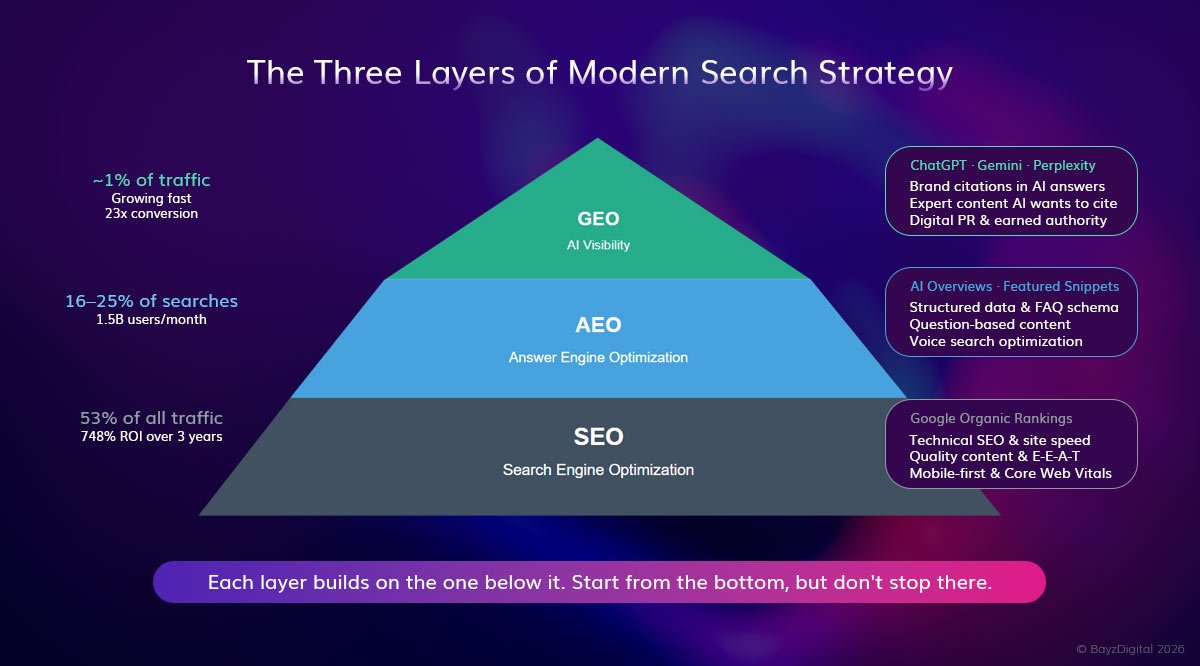
Google still processes over 8.5 billion searches every day. Organic search still drives more than 53% of all website traffic. SEO leads still convert at 14.6% nearly nine times better than outbound marketing.
But two massive shifts are happening at the same time.
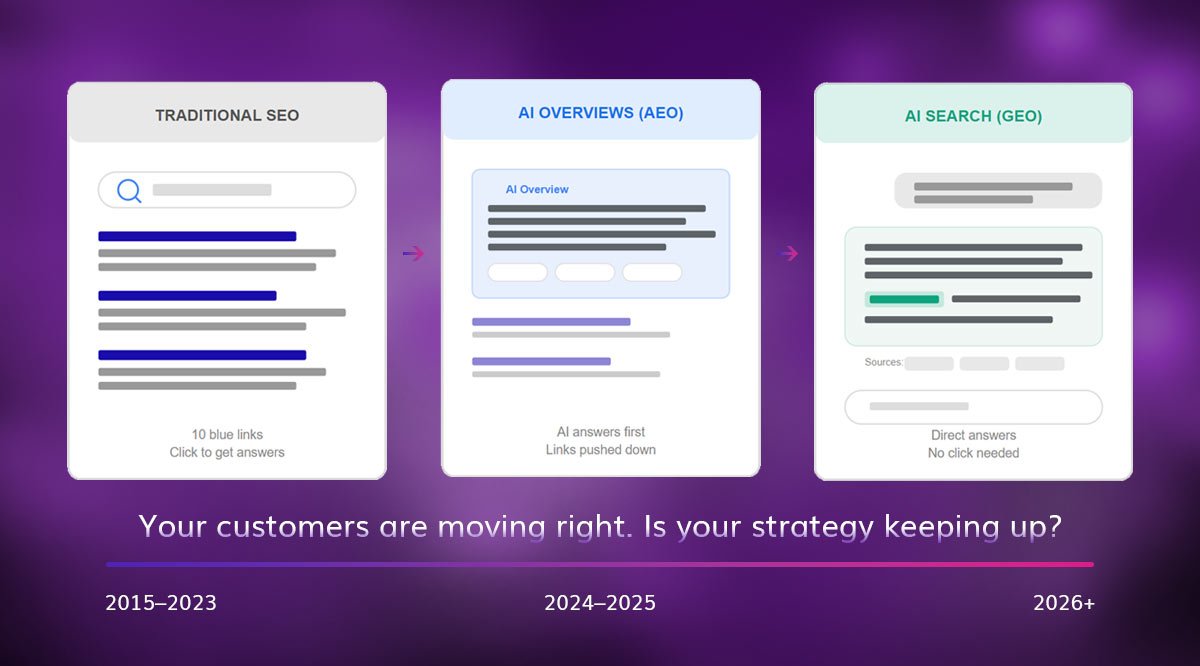
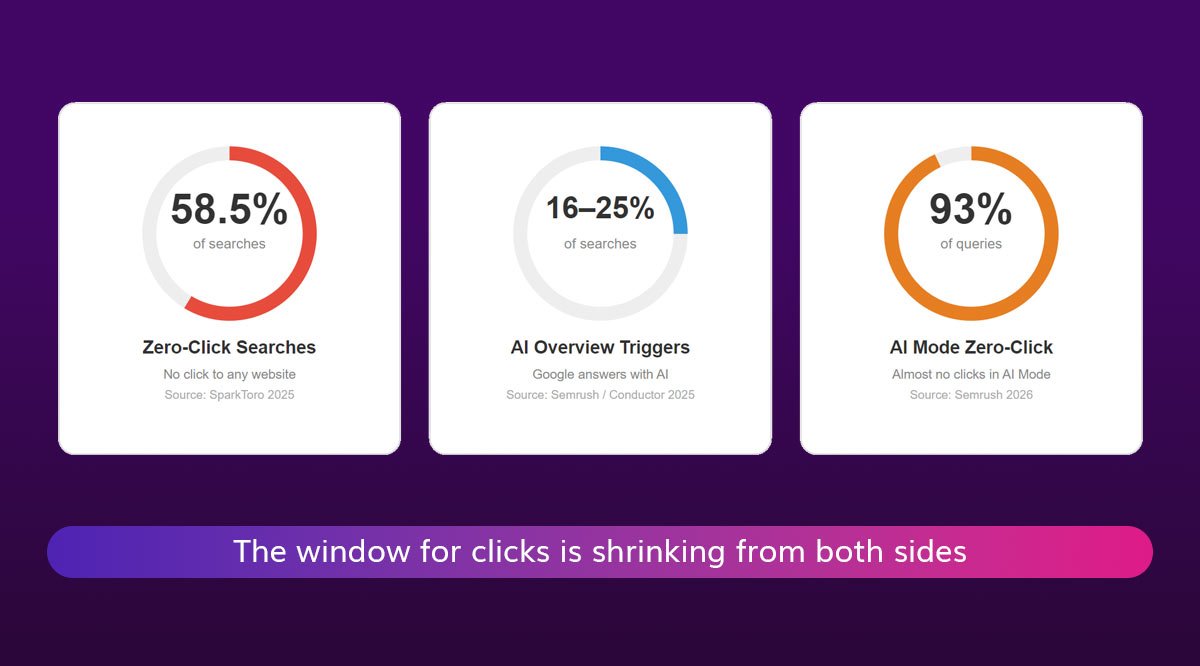
First, 58.5% of Google searches now end without a single click — according to SparkToro’s primary research. Google answers the question right there on the results page. Your website might rank perfectly and still get no visitors from that ranking.
Second, Google’s AI Overviews now appear in 16–25% of all searches, reaching 1.5 billion users monthly across 100+ countries. On January 27, 2026, Google upgraded these AI Overviews to its most powerful model yet — Gemini 3 — and added follow-up questions that seamlessly pull users deeper into AI-powered conversations instead of clicking through to websites. When AI Overviews do appear, Semrush data shows zero-click rates spike to 43% and in Google’s new AI Mode, that number hits a staggering 93%.
Meanwhile, millions of people now bypass Google entirely, turning to ChatGPT (900 million weekly users), Google Gemini (750 million monthly users as of February 2026), and Perplexity AI to find information and make purchasing decisions. And the competitive landscape is shifting fast ChatGPT’s U.S. mobile market share fell from 69% to 45% between January 2025 and January 2026, while Gemini surged from 15% to 25%. The AI search audience isn’t consolidating around one tool. It’s fragmenting which means businesses need to be visible across multiple platforms, not just one.
This isn’t a prediction about the future. It’s happening right now.
What this means for your business
The practical impact is straightforward: even if your SEO is working perfectly, you could be invisible in the places where a growing number of your potential customers are actually looking.
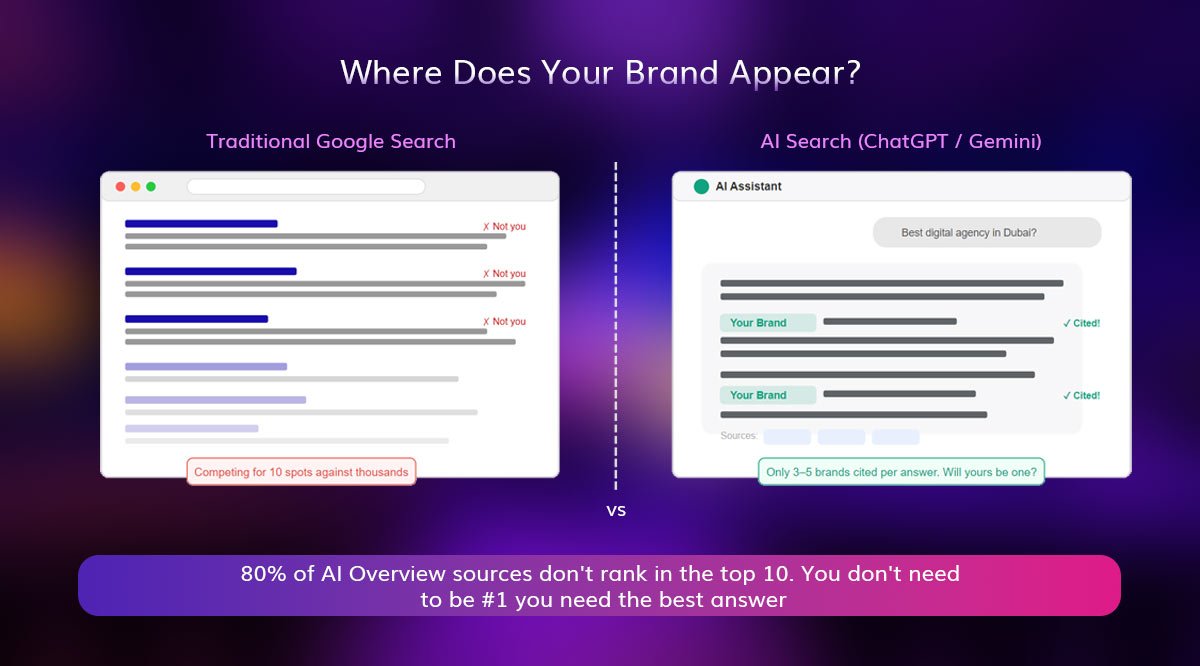
When someone asks ChatGPT “What’s the best digital marketing agency in Dubai?” or asks Google a question that triggers an AI Overview will your business show up in the answer?
For most businesses, the honest answer is no. And that’s a problem, because the data is clear: these AI-powered answers are becoming a real discovery channel. Ahrefs found that AI search visitors made up just 0.5% of their traffic but drove 12.1% of signups converting at roughly 23 times the rate of traditional organic search. Seer Interactive’s broader 50-client study showed a more conservative but still significant 1.5x conversion advantage.
The opportunity is real. But so is the nuance: AI search currently drives roughly 1% of total website traffic, and 95% of ChatGPT users still also use Google. This isn’t replacing traditional search yet it’s adding a new layer on top of it.
At BayzDigital, we think of this as an evolution, not a revolution. The businesses that build visibility across both traditional and AI-powered search now will have a massive advantage when these channels scale and they’re scaling fast. Think of AI search today the way you’d think about Google in 2005: small in absolute numbers, but growing at a rate where the early movers won’t need to fight for position later.
This is the shift that Reynolds understood before most. Traffic is becoming a vanity metric. What matters now is whether your brand shows up in the right places whether that’s a Google search result, an AI Overview, a ChatGPT recommendation, or a Perplexity citation. Conductor’s CEO summed it up well: “AI hasn’t replaced search it’s replaced your website as the first touchpoint.”
The right foundation still matters but don’t overdo it
Before chasing the new, make sure the fundamentals are solid. SEO remains the highest-ROI digital marketing channel, delivering a median return of 748% over three years.
But here’s something most agencies won’t tell you: more SEO is not always better SEO.
Lily Ray, one of the industry’s most respected SEO analysts, found in her December 2025 analysis that websites are actually losing rankings because they’re doing too much optimization. Tactics that generated strong results between 2018 and 2022 aggressive keyword targeting, mass content production, link-building playbooks now actively trigger Google’s spam systems.
Google’s February 2026 core update reinforced this hard. Sites relying on mass-produced AI content are seeing significant declines, while AI-assisted content enhanced by genuine human expertise continues performing well. Google is increasingly rewarding what they call “Information Gain” content that adds something genuinely new beyond what already exists online. If your article just restates what ten other articles already say, Google has less reason to rank it and AI systems have less reason to cite it.
Google also launched its first-ever Discover-specific core update in February 2026, favoring locally relevant content, original reporting, and in-depth expertise. For UAE businesses, this is significant: Discover now prioritizes content from websites in the user’s own country, giving local businesses an edge over generic international content.
The goal isn’t more content. It’s better, more genuinely expert content.
Showing up where the answers are
If nearly 60% of searches end without a click, the question becomes: how do you make sure your brand still shows up in those zero-click results?
This means getting your content featured in the places where Google and AI tools answer questions directly featured snippets, “People Also Ask” boxes, and AI Overviews. Pages with FAQ schema markup are 3.2 times more likely to appear in AI Overviews. “People Also Ask” boxes appear in 64–78% of Google searches and regularly pull answers from pages that don’t rank in the traditional top 10. And here’s a genuine opening for smaller businesses: 80% of sources cited in AI Overviews don’t rank in the traditional top 10 at all. You don’t need to be a market leader to get cited you need to have the best answer.
For UAE businesses specifically, this intersects with voice search over 85% of UAE residents have used voice assistants, and 76% of voice users search for local businesses. If your content doesn’t answer questions in both Arabic and English, you’re invisible to a significant segment of searchers.
The AI visibility gap
Alongside Google, the AI search landscape is fragmenting fast. ChatGPT, Gemini, and Perplexity are all growing but here’s what’s important to understand: they all work differently, and the results change constantly.
A January 2026 SparkToro study tested 2,961 prompts across ChatGPT, Claude, and Google AI and found something striking: AI tools produce different brand recommendations nearly every time. There’s less than a 1-in-100 chance of getting the same brand list twice. As Rand Fishkin put it, any tool claiming to show you a fixed “ranking position in AI” is misleading.
What does remain consistent is how often a brand gets mentioned which is driven by the same fundamentals that have always mattered: genuine expertise, authoritative content, earned media, and a strong brand presence across the web.
A landmark Princeton University study found that specific content optimization methods can boost visibility in AI responses by up to 40%. The most effective approaches? Adding statistics and citations, demonstrating clear expertise, and ensuring content completely answers the question rather than just targeting keywords. Traditional SEO tactics like keyword stuffing actually performed poorly. Mike King of iPullRank named Search Engine Land’s 2025 AI Search Marketer of the Year describes it as a “raffle ticket” system: the more relevant, authoritative passages your content contains, the more chances you have of being surfaced in any given AI response.
The industry is still debating what to call these strategies GEO, AEO, AI SEO, or simply evolved search optimization. The labels don’t matter. The tactics do. And the core of what works hasn’t changed as much as the hype suggests: create genuinely useful content, demonstrate real expertise, earn trust from authoritative sources, and structure your information so both humans and machines can easily understand it.
What should you do about this?
If you’ve read this far, you’re probably thinking: “Okay, I get it. SEO alone isn’t enough. But where do I actually start?”
The honest answer: it depends on where your business is today.
If your SEO fundamentals aren’t solid yet, start there. Your website needs to be fast, mobile-friendly, and built on quality content. Remember, 79% of UAE e-commerce purchases happen on smartphones — if your site doesn’t work well on mobile, nothing else will matter. This is the foundation everything else sits on.
If your SEO is working but leads are plateauing, it’s time to optimize for the answer layer — structured data markup, featured snippet opportunities, and content structured around the real questions your customers ask in both Arabic and English. This is where most UAE businesses start seeing results quickly, because so few competitors in this market have done it well.
If you want to get ahead of competitors, start building AI search visibility now. This is where the complexity increases — auditing your brand’s presence across AI platforms, building the kind of authoritative, data-rich content that AI systems want to cite, and investing in the digital PR and earned media that signals trustworthiness to both traditional and AI-powered search.
That third layer is where most businesses need a partner. The landscape is new, the tools are evolving weekly, and the strategies that work require a level of specialization that most in-house teams haven’t built yet.
“But isn’t this just another marketing trend?”
Fair question. Every year brings a new “everything has changed” headline, and most of them don’t pan out.
Here’s why this one is different: the data is already here. Zero-click searches aren’t a prediction they’re 58.5% of current Google searches, verified by primary research. AI Overviews aren’t a beta feature — they reach 1.5 billion users monthly and Google just upgraded them to their most powerful AI model. Conductor’s 2026 benchmark report — surveying 250+ digital leaders — found that 97% reported positive results from AEO/GEO strategies in 2025, and 94% plan to increase their investment this year. This isn’t fringe thinking anymore.
And in the UAE specifically, the government isn’t treating AI as optional. The National AI Strategy targets 45% of GDP contribution from AI by 2031. Abu Dhabi is building the world’s largest AI data center cluster. Enterprise AI adoption is already at 58%. The businesses around you — your competitors are paying attention to this shift even if they haven’t acted yet.
As Google’s own John Mueller said in January 2026: “What you call it doesn’t matter, but ‘AI’ is not going away… be realistic and look at actual usage metrics and understand your audience.”
The businesses that evolve their search strategy today won’t just survive the shift. They’ll be the ones their competitors are trying to catch up to tomorrow.
Frequently asked questions
Is SEO still worth investing in for 2026?
What is Generative Engine Optimization (GEO)?
How is GEO different from traditional SEO?
What percentage of website traffic comes from AI search?
How can UAE businesses prepare for the shift to AI-powered search?
Ready to future-proof your search visibility?
At BayzDigital, we help UAE businesses navigate exactly this transition. Our Generative Engine Optimization service combines traditional SEO foundations with AI search visibility strategies specifically designed for the UAE market in both Arabic and English.
Here’s what a conversation with us looks like: we’ll audit where your brand currently appears (and doesn’t) across Google AI Overviews, ChatGPT, Perplexity, and Gemini. Then we’ll show you exactly what it’ll take to close the gaps with a prioritized action plan tailored to your industry and budget.